Why Drainage Comes First: What to Know Before Building a Patio or Wall in Middle Tennessee
On the Cumberland Plateau, drainage isn't an upgrade — it's the foundation. Here's why every hardscaping project starts below ground.
If you're planning a paver patio, retaining wall, or walkway in Crossville, Cookeville, or anywhere on the Cumberland Plateau, there's one step that matters more than any material choice, color, or pattern: drainage. Skip it, and your project will fail — sometimes within a single season. Here's what every Middle Tennessee homeowner should understand before the first shovel hits the ground.
Why the Cumberland Plateau Is Different
Middle Tennessee's terrain is not like most of the country. The Cumberland Plateau is defined by rolling hills, clay-heavy subsoils, and significant elevation changes. Clay soil holds water instead of draining it, and sloped properties concentrate runoff into predictable channels. When you build a patio, wall, or walkway on top of that without managing water first, you're building on a slow-moving problem.
What Happens When Drainage Is Skipped
We see the same failures over and over on properties where a previous contractor built first and never addressed water:
Every one of these failures is preventable. And every one of them costs more to fix than it would have cost to address drainage upfront.
The Drainage Features That Should Come First
French Drains
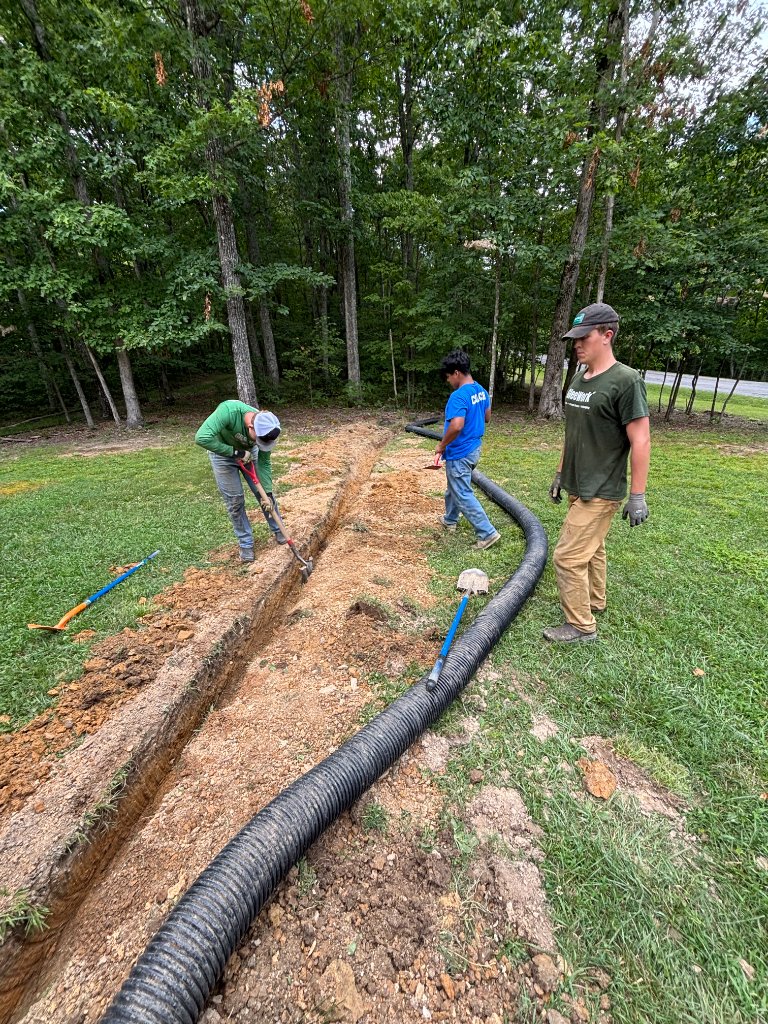
A perforated pipe buried in gravel that collects and redirects subsurface water. On Plateau properties with clay soil, French drains are often the difference between a patio that lasts 30 years and one that fails in 3. They're installed before the base layer — not after.
Surface Grading and Slope
Before any paver or concrete is laid, the ground should be graded to direct surface water away from the project area and away from the home's foundation. A proper slope of roughly 1 inch per 10 feet is standard, but every site is different.
Retaining Wall Drainage
Every retaining wall GleeWork builds includes compacted drainage aggregate behind the wall, geotextile filter fabric, and a perforated drain pipe at the base. This is not optional — it's what prevents hydrostatic pressure from pushing the wall over.
Downspout Routing
Roof water is one of the biggest contributors to yard saturation. Routing downspouts underground and away from patios, walls, and foundations prevents thousands of gallons of water from dumping directly onto your hardscaping every rainfall.
How to Know If Your Yard Needs Drainage Work First
- Water stands in your yard for more than a few hours after rain
- You have visible erosion channels or bare soil streaks on slopes
- The ground feels spongy or soft in certain areas days after rainfall
- Your basement or crawl space has moisture issues
- Your property has any significant elevation change or slope
- A previous patio, walkway, or wall has already failed or settled
What It Costs to Do It Right
Drainage work adds cost to a project, but it's a fraction of what you'll spend rebuilding a failed patio or wall. Typical ranges in the Crossville and Cookeville area:
- French drain (per linear foot): $25–$50 installed
- Downspout underground routing (per downspout): $300–$600
- Surface grading and re-sloping: $500–$2,500 depending on yard size
- Retaining wall drainage (included in every GleeWork wall): no additional charge
The GleeWork Approach
Every GleeWork estimate includes a drainage assessment. We walk your property, identify how water moves across it, and build drainage into the project scope before we ever quote a patio, wall, or walkway. That's why our hardscaping holds up — we start below ground.
FAQs
On most Cumberland Plateau properties, yes. Clay soil and sloped terrain mean water will move beneath your patio unless it's managed. A proper base with drainage features prevents settling, heaving, and joint separation.
It depends on the site, but typically drainage work adds 10–25% to a hardscaping project. That's significantly less than the cost of rebuilding a failed patio or retaining wall.
Sometimes. If the failure is caught early, drainage can be retrofitted. If the base has already washed out or the wall has shifted significantly, partial or full rebuild is often the only option. That's why we recommend addressing drainage first.
Yes. We install French drains, downspout routing, surface grading, and dry creek beds across Crossville, Cookeville, and surrounding Middle Tennessee areas — whether or not you're planning a hardscaping project.
Start Your Project Below Ground
Get a free estimate with a drainage assessment from GleeWork.
Get an Estimate
Luna
GleeWork Assistant · Typically replies instantly